


How We can fix your pain points
Email response time
Why Email response time matters
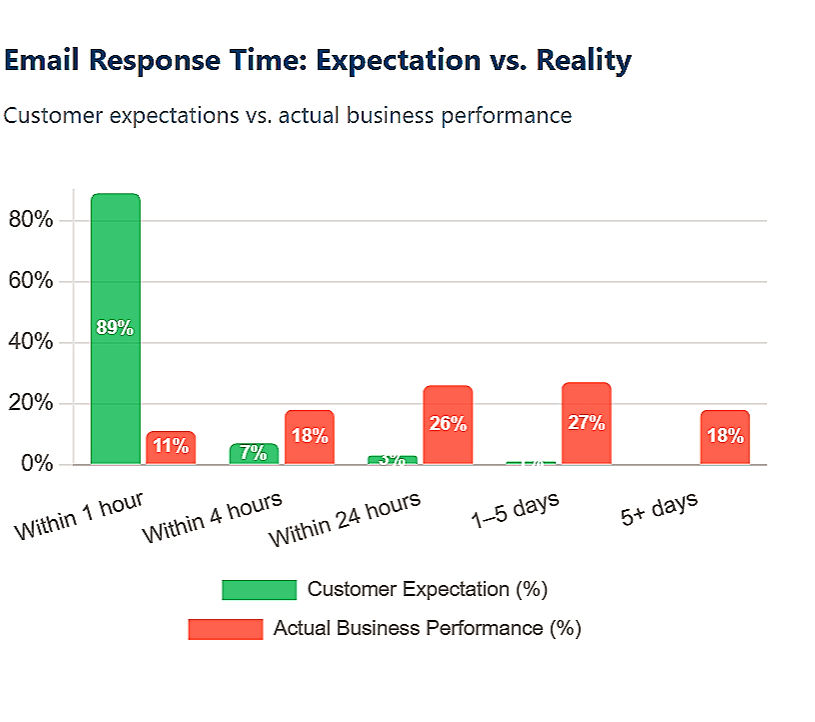
In today’s hyper-connected economy, email response time has evolved from a customer service courtesy into a primary driver of revenue and retention. Research indicates a staggering disconnect between business performance and consumer expectations: while the average business takes over 12 hours to respond, 89% of customers now expect a reply within one hour [1]. This "expectation gap" represents a significant risk to lead conversion, as studies show that following up with a prospect within 60 minutes increases your success rate by 700% compared to waiting even a few hours longer [2].
For small and medium-sized businesses (SMBs), the stakes are even higher. Speed is often the only differentiator against larger competitors. When a response is delayed, 71% of customers feel the business is disorganized, leading to "inbox anxiety" and a 40% drop in overall perceived brand trust [3]. By implementing AI-driven automation to ensure near-instantaneous, 24/7 engagement, businesses can reclaim the 28% of the workweek currently lost to manual email management while ensuring no lead is ever left cold [4].
-
EmailAnalytics (2026): "Customer Service Email Response Time Standards by Industry."
-
Forbes (2024): "Why Email Response Time Is The Best Customer Service KPI."
-
Drag Email Statistics (2025): "The Impact of Communication Speed on SMB Growth."
-
McKinsey & cloudHQ (2025): "Workplace Email Statistics and Productivity Analysis."
Automation growth
Stay ahead of the curve
The AI email chatbot industry is undergoing a seismic shift, with the Canadian market alone projected to grow at a 22% CAGR, reaching an estimated $2.83 billion by 2033 [1]. This explosive growth is driven by a fundamental change in business operations: 71% of Canadian SMBs have already integrated AI tools to combat the "infinite workday," where employees spend up to 28% of their workweek managing overflowing inboxes [2]. As global daily email volume is set to surpass 392 billion messages by 2026, traditional manual triage is no longer a sustainable strategy [3].
Staying ahead of this curve is no longer about "innovation"—it is about survival and scale. Early adopters of AI email automation report saving an average of 5 hours per week per employee, allowing teams to shift from repetitive administrative tasks to high-value strategic work [4]. In a landscape where 75% of your competitors are already planning to increase their AI investment this year, the window to capture a "first-mover" advantage in Central Alberta is closing [2]. By adopting AI now, you ensure your business remains responsive, scalable, and competitive in an increasingly automated economy.

-
Grand View Research (2025): "Canada Chatbot Market Size, Share & Trends Analysis Report 2025–2033."
-
Microsoft SMB Report (2025): "Majority of Canadian SMBs Embrace AI to Drive Efficiency and Growth."
-
cloudHQ (2025): "Email Statistics Report 2025–2030: Global Volume and Usage Trends."
-
Forbes (2025): "AI Saves Employees 5 Hours A Week — But Who Really Benefits?